By: Lindsay Fortin
I love to write, but I have a difficult time finishing first drafts. Oftentimes I get caught up in the prose, the planning, the details… One time I spent a year and a half on a project and only got to the 22,000 word mark. That’s fine, by the way, if that’s the way you prefer to work! But I find myself getting lost in the details, and that makes it difficult to follow through and finish it. I overthink and want it to be perfect. I compare it to other people’s finished and edited books. I feel like nothing I write is good enough, and I get stuck on rewriting the same scenes over and over again to refine them.
So. What do I do? How do I get around that?
1. Draft Zero
In my mind, I don’t start with a first draft. I call it “draft zero.” That helps take a ton of the mental pressure off, and truly allows it to be bad. No first drafts are good. But draft zero? Draft zero can be a detailed, 70,000 word outline. What do I mean by a detailed, 70,000 word outline?
2. Oversimplify
I force myself to get overly simplistic with my writing. I’m all about making writing pretty and having it flow nicely. But I will spend hours on one scene, trying to get it to sound nice. So for example, what I make myself do is:
- She *did action.*
- She *felt this, heard this.*
- *This is briefly what she sees.*
- *This is why this is happening.*
- *This person says this.* Protagonist replies, *this*
In practice, this is what that looks like:

I allow it to be oversimplified. In fact, I force myself to write this way. The sentence structure is very basic. Notice, “She did x. She was x. It was x.” When I come back to it, I’ll rewrite it entirely. This is a very (very) expanded outline. It shows me scene beats, character moments, actions, and dialogue. It moves the plot forward because I’m not getting lost in making it pretty. I write much, much faster as a result, and have been getting through the story quicker than I’ve ever done in the past.
3. Grouping
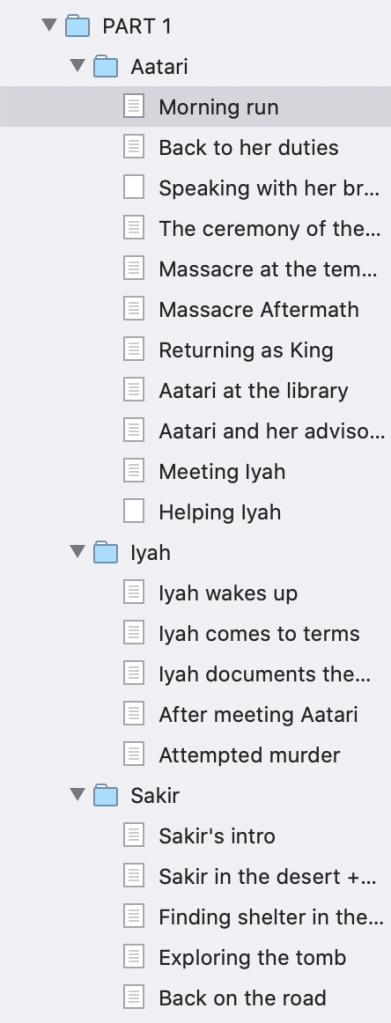
I used to be concerned with putting things in the correct order in the first draft, but what order they’re in right now doesn’t matter in the slightest. So instead what I’m doing now is grouping it into parts, then dividing it by character. So for example, these will all be mixed together when I edit later, and they’ll hopefully all flow into one another. But with 3 POVs, it’s much easier for me to write scenes in chronological order for each character. I also know which scenes have to happen in part 1, 2, and 3 for each character, and organizing my scenes this way helps me keep focused. To be clear, these aren’t even necessarily chapters yet. They average from about 1,200 – 1,800 words each (some far less), but I don’t consider them chapters at this point. They just mark important points in the story that need to happen. They’re not as fully organized and well thought out as chapters yet, and that’s okay! That will come later on.
4. Write down notes for improvement and move on
Rather than editing something when I get an idea for how to improve it as I’m writing, I’ll make a note of it in the document and continue moving forward. Unless it’s a burning idea that needs to be written out now before I forget, I force myself to keep going. This gives me the freedom of hindsight, and I’m able to make a more informed decision about it when I’m editing. Maybe the way I would have initially rewritten it was good, but after finishing draft zero I have options I didn’t even know were available before because I hadn’t seen them yet. Then I’m not rewriting a scene three times — just once or twice. It makes getting through draft zero much easier.
Concluding Thoughts
When I implemented these things, I began to write so much faster. In a previous WIP, I’d spent a year and a half getting to 22,000 words. With this WIP, I reached 22,000 words in about five weeks — which for me is a miracle.
But most importantly, don’t be too hard on yourself if you’re a “slow” writer. You move at your own pace, and that’s okay. With persistence, and maybe a couple of tricks up your sleeve, you will get there!
 Secret Writers Guild