
By: Mariah Prouse
I am not an editor. Yet, I cannot deny that I edit and revise my novels to the best of my ability. So, I guess I am just in denial. Anyone else?
But editing is a part of the process that leads towards a completed novel. After all, the first draft is not going to be a polished piece ready for everyone’s eyes. Or maybe you are one of those people who shares your first draft with critique partners. For me, the first draft will be for my eyes only—no matter how good I wish it to be, the truth is I know it is not.
The question remains, that if you are not an editor though, how do you go about doing your best to edit your manuscript (MS)? It has taken some practice for me to refine my process and I am still learning what is best, but thought I would still share with all of you some of what I have learned and put into practice.
- Leave It
That’s right. I said it. Once you complete the first draft, step away from it. NO matter how tempting it may be to start editing, it is for the best that you put it off to the side. Go read. Start a new story. Do some writing prompts or research for new ideas. I have three separate manuscripts right now at various stages. One of them is nearing final edits. Another is in the revision stage after the completion of the first draft, and the final one is brand new and shiny. Having these options has been great because while my manuscript is with readers or in this “leave it” stage, I have something else to keep my attention preoccupied. How long do you leave it, you may ask? I would recommend at least two weeks, but a month is even better. It may seem torturous, but in the end, you’ll be glad you did it.
2. Read it Aloud
You have left it for a while and now it is time to open that document once again. If you left it a month, it is almost unfamiliar to you anymore and that is honestly a good thing. Now it is time for the next step. I have discovered the wonderful option of having Word read my MS to me. My first draft is written in Scrivener and then I transfer it to a word doc. The doc is read aloud and then I make the changes in the Scrivener version. If possible, you can either print out a copy to make notes on (but remember how important the environment is, so don’t do this for every round please) or have a second screen open to edit while it reads aloud to you. Another option is to read it aloud yourself. I prefer the option of the program reading it to me because it notices things I might not have at first glance (or second…or third). Also, I can put in headphones so my family doesn’t hear my blunders, or scenes they shouldn’t either—young kids in this house.
3. Make Notes
While you are reading it aloud, you might note some issues with plot holes or other problems that you need to fix. I do not do this at this time, instead I just note it. Why? Because otherwise I get off track and usually fall down a rabbit hole. At this point of the process, I don’t want that to happen. So, I have a notebook (or using the note sections in Scrivener) where I will jot down what I need to fix if they are bigger things besides fixing sentence structure or spelling issues.
4. Editing Checklists
Did you notice a word you used to often? Maybe a gesture that is overdone? How about a character who had moments that they didn’t seem to be themselves? I take the notes from above and create an editing checklist for each chapter. In it, I might add more specific notes for certain scenes or chapters based on those plot holes I mentioned above. I then use this checklist for each chapter and check off those things I need to fix or search for. This way I will know when each chapter is done with all my boxes have been checked off. For Example:
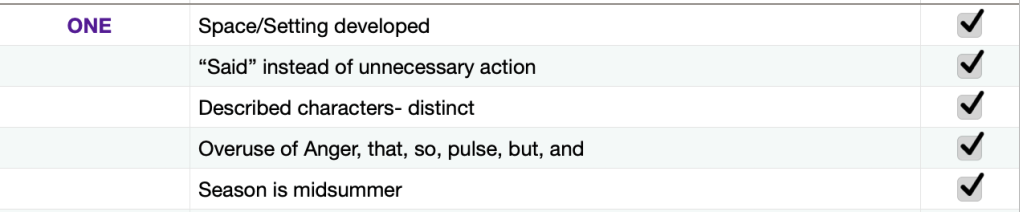
5. Beta Readers and Critique Partners
I have now made all the changes I have noted through the above checklist so guess what time it is? Time to send it off to my trusted beta readers and critique partners (CP). After I have done this entire process once, I usually send it to at least two of each if I can. This is another one of those waiting moments that can be difficult to do, so go back to that aforementioned wait process and don’t touch the MS during this time. You might even have a complete realization of something you missed and that is okay. Just note it and be patient. Otherwise, you will be fixing things more times then necessary and you might as well do it all at once. Also, by waiting, you are giving yourself that chance to have fresh eyes on it when you do come back to it.
6. Do it ALL Over Again
You might be cursing me at this point. Yes, you will need to do it all over again. Not only now do you have readers input, but you have all the other things you may have realized during the waiting process. You can usually skip the “Read Aloud” portion again, but even after you make all the changes you deemed appropriate from your CP’s and readers, it isn’t a bad idea to still listen to ensure the changes still flow well. Usually the second round, there is less of the overall things to look for. But I would be lying if that is always the case.
Sooner rather than later though, you will have less changes, less overall constructive feedback, and your MS will be ready to query, or in other cases, publish if that’s the route you’re taking. I also highly recommend leaving the major line edits till the end. It bothers some, so you do you, but in some cases, sentences and scenes could have an entire change and if your editor brain is at all like mine, those can wait till those last draft read throughs.
Good luck! Keep on writing and persevere! If you have any other ideas, or want to share your process, please share them in the comments below because I would love to hear them!
 Secret Writers Guild